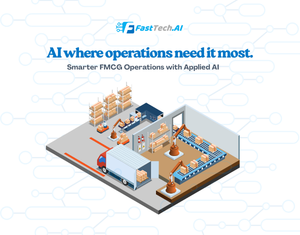
Many FMCG and consumer health companies are already exploring AI. Some have tested forecasting tools, maybe a few piloted automation projects, and some others tried chatbots.
But still a common question remains at leadership level:
Where does artificial intelligence actually make a difference in the way things are done? Artificial intelligence is supposed to help us get things done better and faster. So where does artificial intelligence actually deliver value to the people who use it?
From what we see across FMCG organizations, the biggest improvements do not come from fancy AI features. They come from using AI to help with problems that these companies face. Where complexity, volume, and manual effort already exist. So, it's not replacing people but it is supporting better decisions and of course a faster execution.
Based on what we see and we understand, in FMCG operating environment typically have conditions like:
- Demand that keeps changing across periods and regions
- Promotions that quickly shift buying patterns
- Distributor onboarding that is document-heavy and multi-step
- Product and contract information spread across multiple system
- Repeating customer and partner inquiries across channels.
We are aware that none of these challenges are new. Although, the way it happens now is different because they happen much faster and on a bigger scale. What used to be manageable through manual coordination and static reports now requires faster signals, better visibility, and more consistent execution support.
This is where applied AI solutions begin to make sense in a way. Where AI is not replacing people. Instead, help people do their jobs better. AI can really make a difference in the way teams work.
- AI-assisted demand planning and forecasting helps improve forecast quality and responsiveness.
- Optimization and scheduling models support better resource allocation under real constraints.
- Document intelligence and automation reduce manual review and verification effort across onboarding and contract workflows.
- Conversational AI agents provide guided responses for distributors, partners, and customers improving consistency while reducing repetitive support load.
Not everywhere. Not all at once. But where the operational load is highest and the decision impact is real. The shift is not from “manual" to "fully automated.” It is from "manual" to "AI-assisted decisioning".
Teams still own decisions. AI reduces noise, repetition, and processing burden. That means:
Faster planning cycles
Lower operational risk
More consistent responses
Better visibility across workflows
Scalable support without proportional headcount growth
At FastTech.AI, we work on AI that is really useful for FMCG businesses. We use AI for planning, automation, optimization, and guided interactions. The goal is measurable operational improvement, not technology for its own sake.
We’ve summarized these practical AI use cases and solution patterns in a concise overview deck.
Explore the AI use case overview for FMCG and see where practical AI can fit your operations