
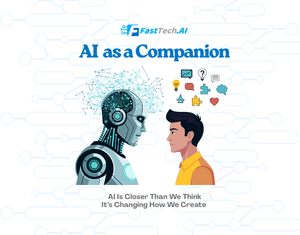
Unconsciously, AI is no longer something we interact with only through chat windows. It's slowly moving into how we design, write, illustrate, and build (in fact, often faster than we realize!). In recent day, people able generate website layouts, illustrations, brand visuals, or even full product mock-ups in minutes. Right now, task that once required years of learning or collaboration can start with a prompt!
For many, AI has become a shortcut to creation and with that, an interesting question came up:
"is this progress or we are skip something important along the way?"
Well, all this time we know that creating means learning. Like for instance:
Designers learned composition, colour, and hierarchy
Developers learned structure, logic, and systems
Writer learned how to think, revise, and shape ideas.
But now, many people are creating without deeply learning the craft. They directly using AI to generate illustrations, generates writes, landing pages, or entire websites without ever opening a design tool or writing a line of code. Perhaps, this isn't necessarily wrong. In fact, for many businesses and individuals, somehow it's empowering. AI indeed lowers barriers, speeds up execution, and helps ideas move faster from concept to reality. Although, it also changes how we relate to the work.
There's a clear upside. AI help teams to:
Move faster
Prototype ideas quickly
Reduce dependency on scarce skills
Explore possibilities that were out of reach
At the same time, there's a quitter tension underneath:
When creation becomes instant, understanding can become shallow
When output is easy, intention can be unclear
When tools decide how something looks or works, humans may stop asking why
Maybe the risk is not that AI replace creativity... maybe.. It’s that creativity become less deliberate.
One way to look at this scheme is not as replacement, but as role change.
People are moving from:
Designing to directing
Building to shaping
Executing to deciding
The basic or original skillset is evolving. Knowing what to ask, what to keep, and what to reject becomes just as important as knowing how to produce something from scratch. In that sense, AI does not remove responsibility... it redistributes...
Based on this anomaly, Fasttech don’t see this as a simple "good or bad" moment. We take it as a signal. AI being embedded so deeply into creation (design, content, interfaces, workflows) tells us that the future is not about islated tools. It's about how humans and AI collaborate in everyday work.
Maybe with the hype of AI, the question that keep coming back to is "Can AI do this?". But, the questions that fasttech keep coming back is "How should it support people without removing understanding, ownership, and intent?"
Whether it's conversational AI, design assistance, or workflwo automation, the same principle applies: "AI help people think better not think less"
It's getting real that AI is closer to us, faster than we expected. Not just in how we talk to the system, but in how we create and decide. Now, it's time to not to resist that change, but we should approach it thoughtfully. Because in a world where creation is instant, clarity, judgment, and purpose become the real differentiators.